



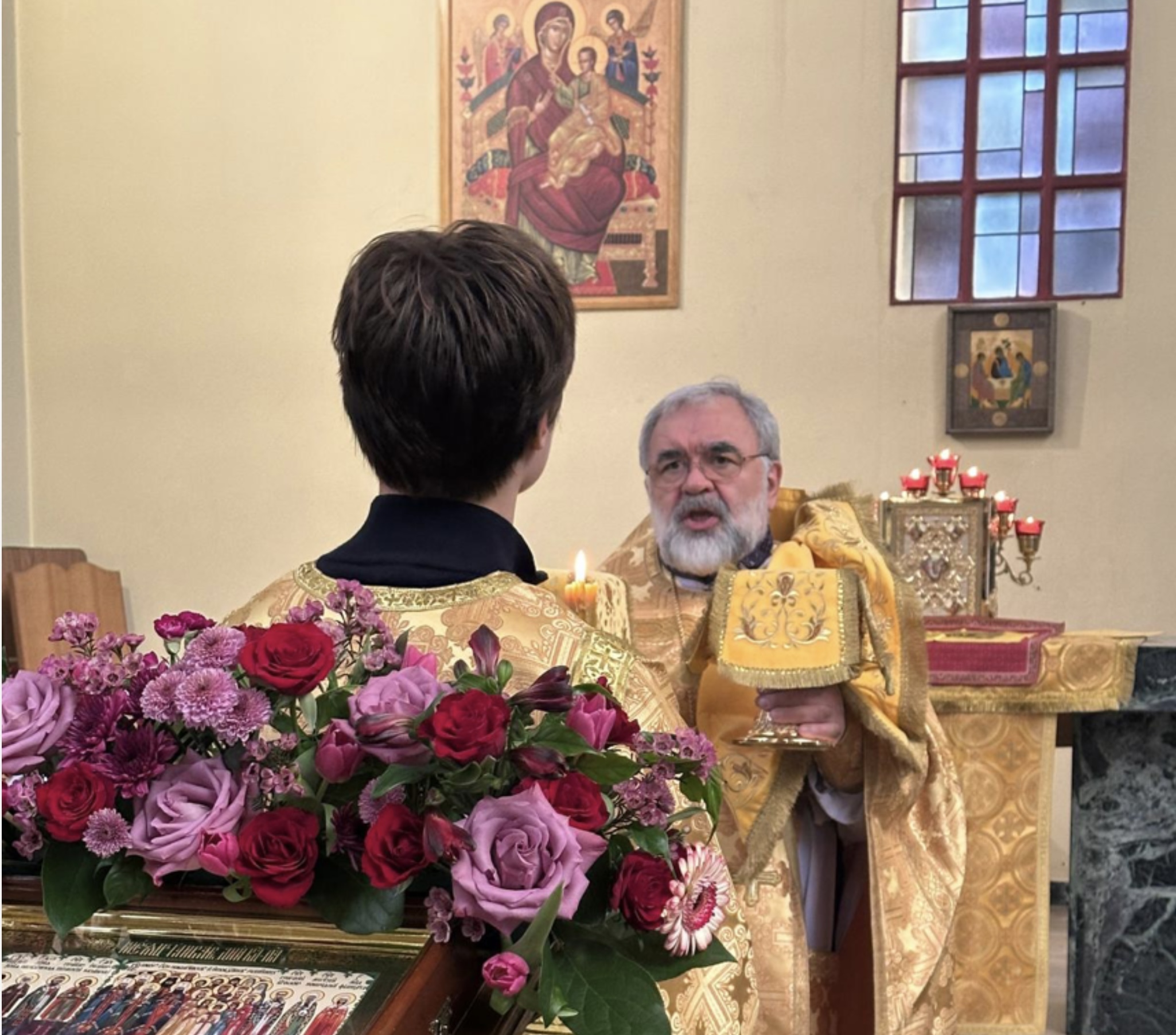
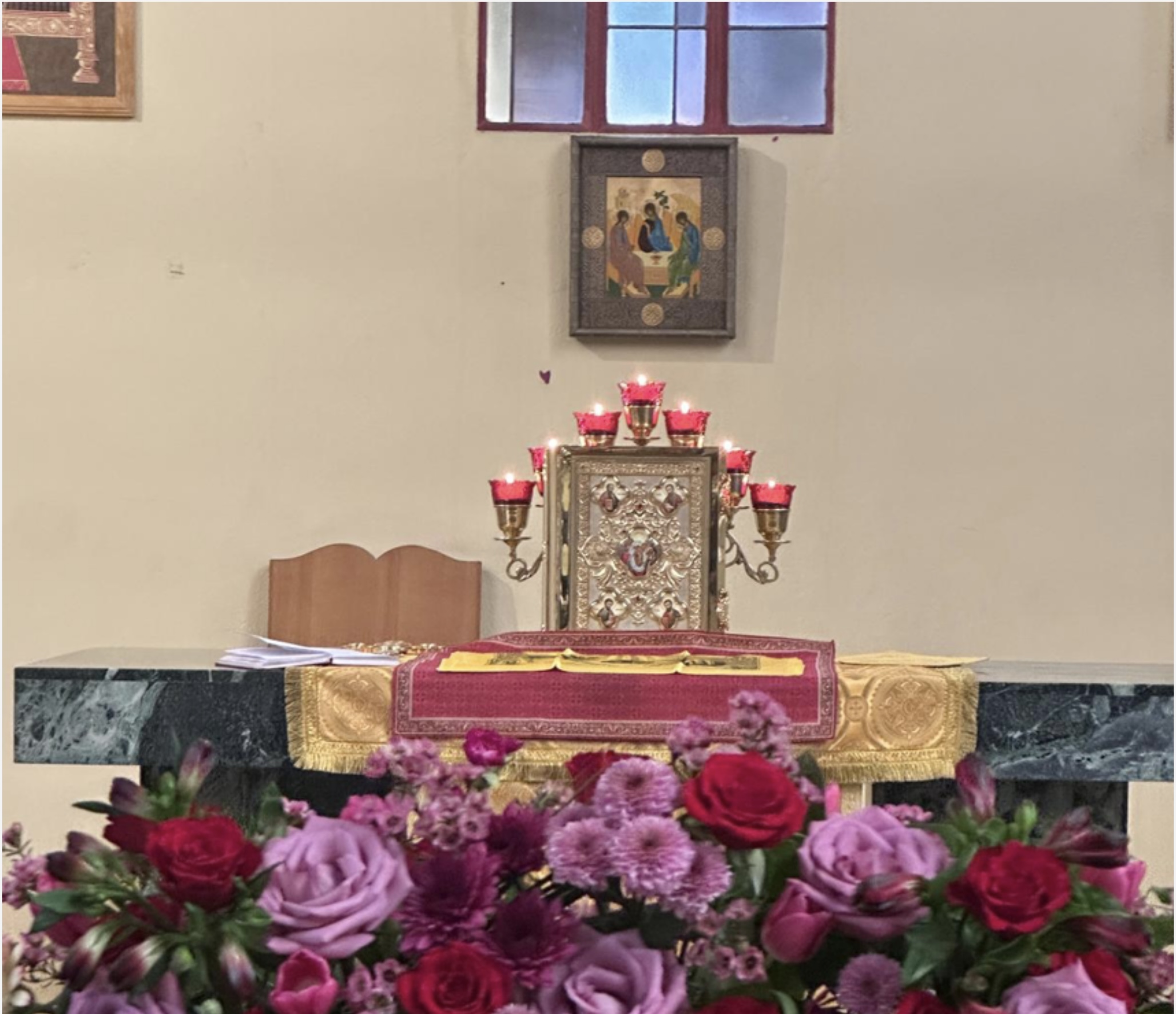
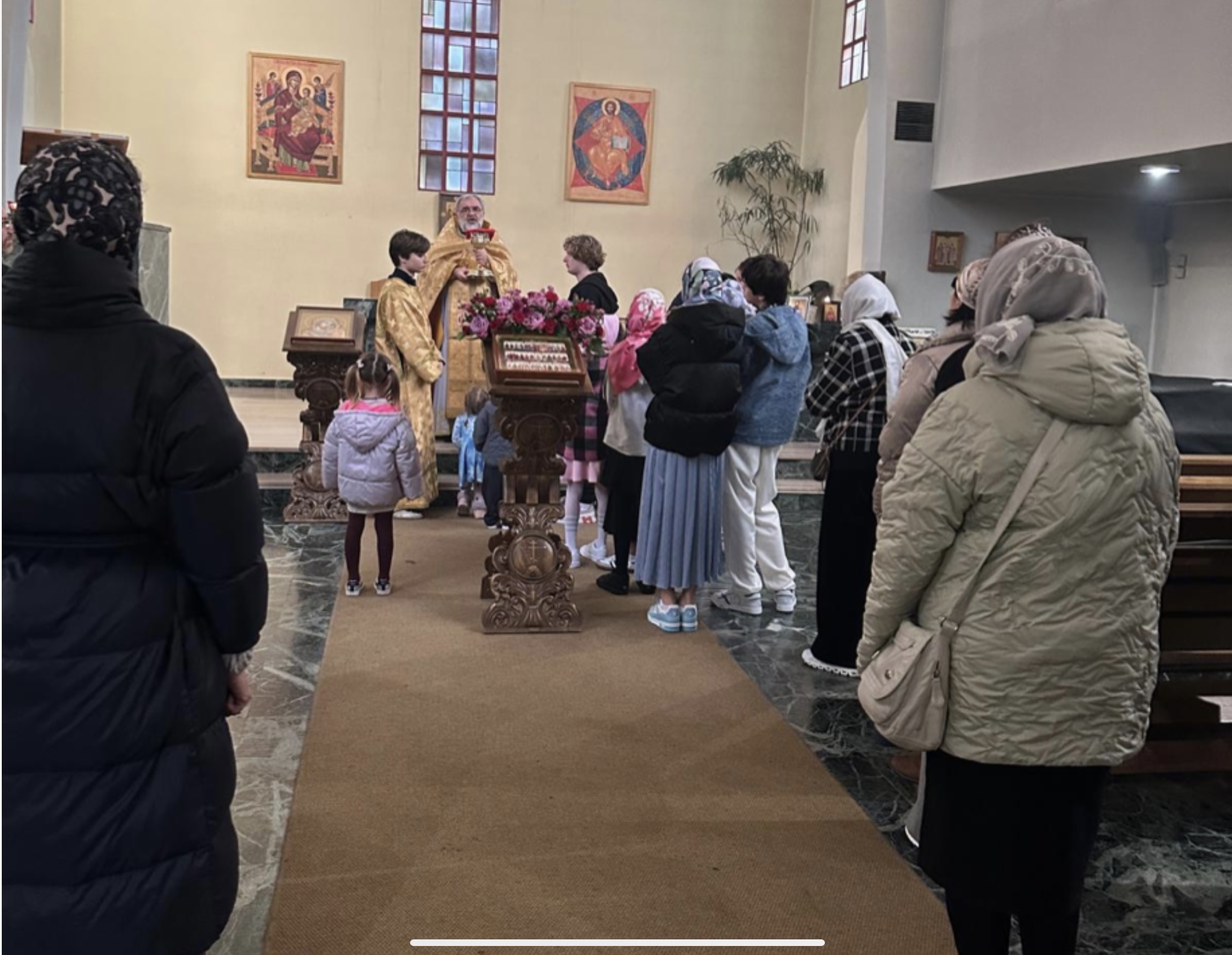
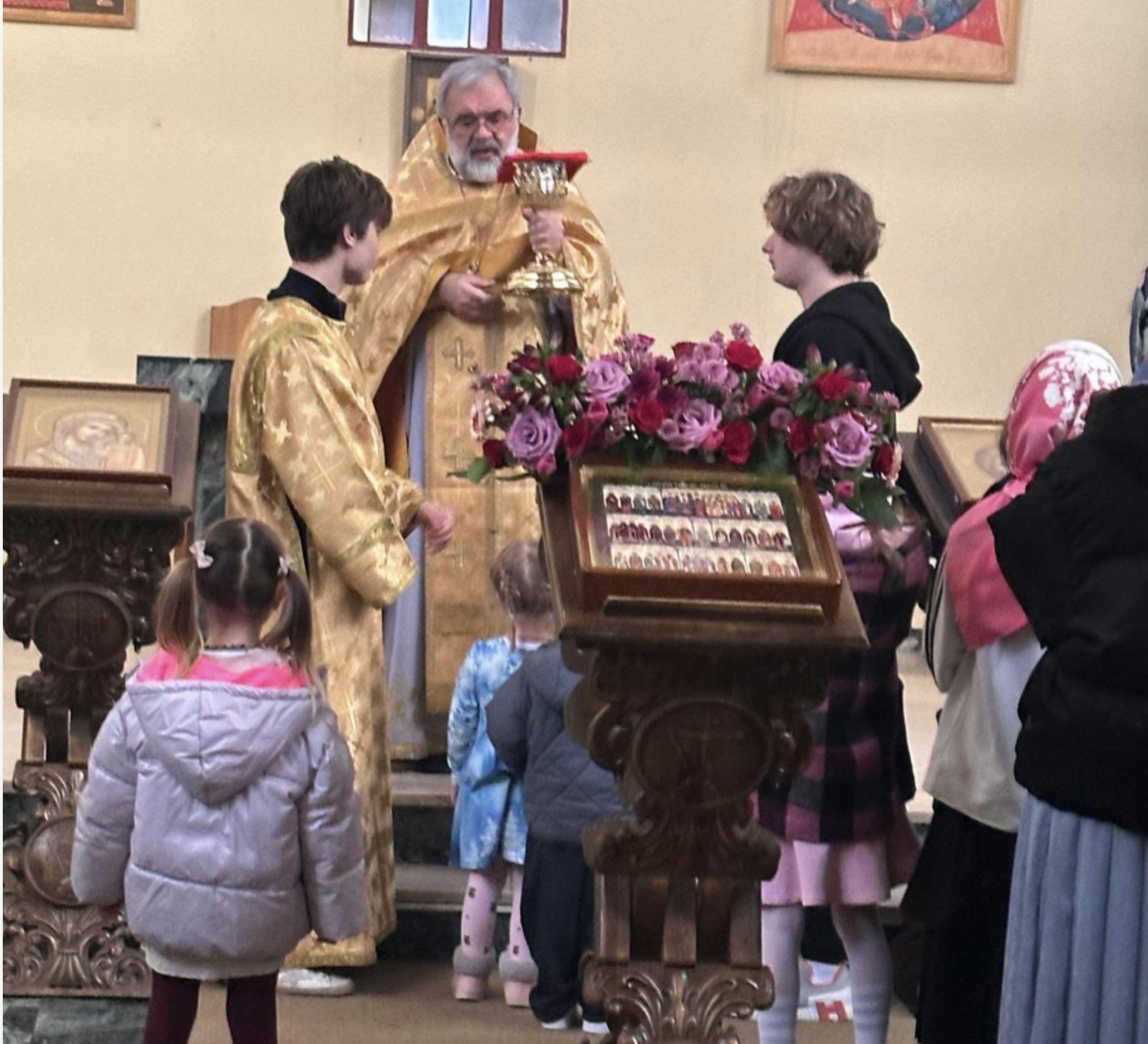
On the Saturday of the First Preparatory Week before Great Lent, the Divine Liturgy was celebrated, presided over by the rector of our parish, Archpriest Vadim Zakrevsky.
On this same day, on the eve of the Sunday of the Prodigal Son, of the Commemoration of the Departed, and of the Synaxis of the New Martyrs and Confessors of the Russian Church, the Holy Church commemorates:
Saint Gregory the Theologian, Archbishop of Constantinople (389);
Venerable Anatoly of Optina the Elder (Zertsalo) (1894);
the Icon of the Mother of God “Assuage My Sorrows”;
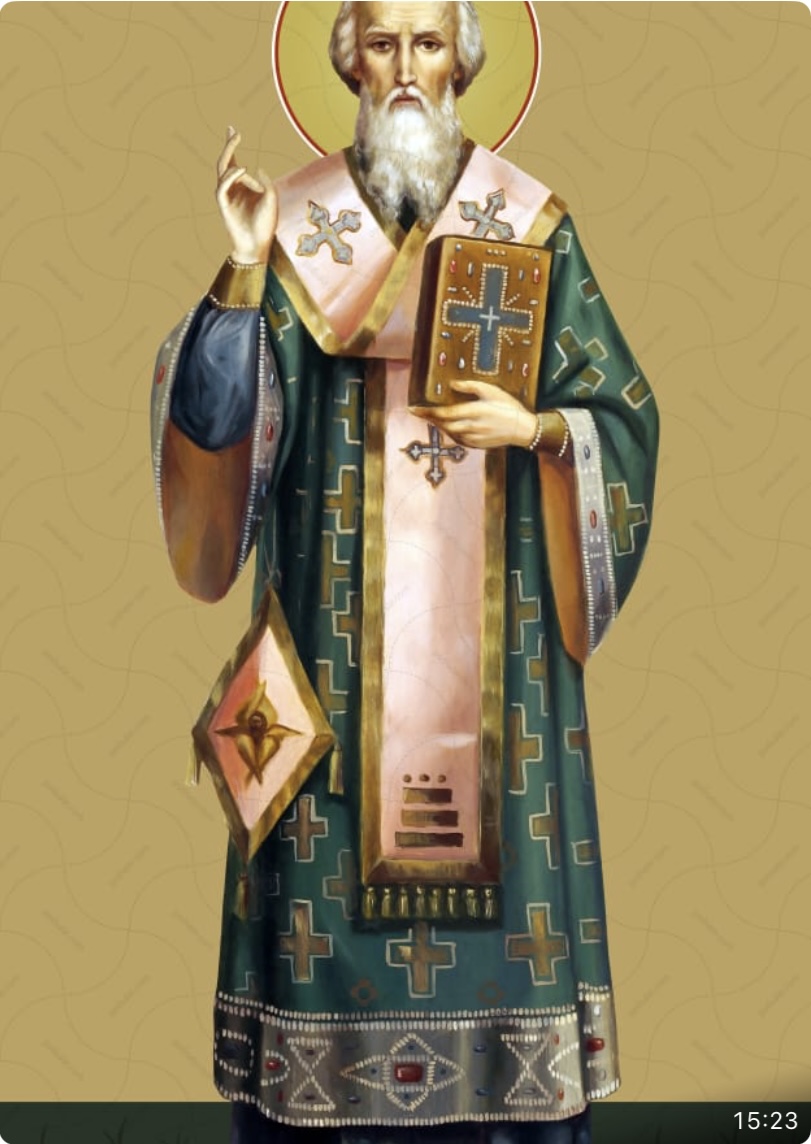
Hieromartyr Vladimir (Bogoyavlensky), Metropolitan of Kiev (1918), the first of the New Martyrs.
In his sermon, drawing upon the Gospel reading appointed for the day, the rector emphasized that in this Gospel the Lord imparts to His disciples an important lesson, reproving the scribes and Pharisees for vanity and ostentatious piety.
It was also noted that although the general rule is the offering of a tenth part of one’s income for the support of the Church, this measure is not formal in character and does not imply any fixed sum, since the means of each person differ. Precisely on the basis of today’s Gospel, the Lord shows His disciples that even the smallest coin placed by a poor woman into the treasury signifies more for Him than the rich donation of a very wealthy man.
The sermon likewise made reference to the publican Zacchaeus, who obtained the Kingdom of Heaven by giving half of his possessions. However, it was especially emphasized that this example must not be understood in a merely formal sense: it is important not only to give away a portion of one’s wealth, but also to change one’s life, one’s heart, and one’s faith.
Furthermore, the rector reminded the faithful that sacrifice to God may be expressed not only in money, but also in the labor of parishioners for the good of the храм — in cleaning, assistance, physical work, and other forms of service. Thus, the matter concerns прежде всего the sincerity of faith, and not its outward demonstration.
It was also said that the more modestly and quietly a person conducts himself, the more pleasing his sacrifice is in the sight of God — even if it be small by outward standards.
Finally, an important point is the parishioner’s awareness that the храм is not “the priest’s church,” but the common church of the entire community, his own spiritual home.
The Life of the Hieromartyr Vladimir
The Hieromartyr Vladimir, Metropolitan of Kiev, was the son of the priest Nikifor Bogoyavlensky, who himself later received a martyr’s end. From childhood the saint was distinguished by modesty and sincerity of heart. By nature he possessed a quiet and meek disposition, and at the same time great aptitude for learning.
Vasily — such was the worldly name of the future hierarch — successfully completed the Kiev Theological Academy, became a teacher, authored several scholarly works, and was ordained to the priesthood. When the wife and child of Father Vasily died, he perceived in this a call from God and embraced the monastic life. Two years later, Hieromonk Vladimir was consecrated to the episcopal rank. The new bishop was then forty years of age, and thirty years remained until his martyrdom.
These years the archpastor spent in labors for the ordering of church life. With all his strength he strove to elevate morality and church-mindedness among the people, who, though considered Orthodox, in practice were increasingly falling under the influence of pagan superstitions and godless teachings, and turning away from God. The святитель himself continually preached and called upon the clergy to instruct the people. His remarkable talks on Orthodox upbringing of children are well known.
In 1898, at the age of fifty, the hierarch became Metropolitan of Moscow. He founded the Moscow Diocesan Society for the Struggle against Drunkenness and, in order to set a good example, completely renounced the use of alcohol himself. A few years later Metropolitan Vladimir was transferred to serve in Saint Petersburg, then the capital of the Russian Empire. The forthright пастырь desired to bring to the Emperor the truth concerning deficiencies in church administration and concerning the person of Grigory Rasputin, but he was transferred to Kiev.
Revolutionary events began. The hierarch knew that they wished to kill him and inwardly prepared himself. He said: “I fear no one and nothing. At every moment I am ready to give my life for the Church of Christ and for the Orthodox faith, if only I may not allow her enemies to mock her.”
On January 25, 1918, the Metropolitan was arrested by the Bolsheviks and, without any trial, shot. When he was brought to the place of execution, the hierarch asked for time to pray. Lifting his hands to heaven, he prayed aloud: “O Lord, forgive my sins, voluntary and involuntary, and receive my spirit in peace.” Then he blessed his murderers with the sign of the Cross and said: “The Lord blesses you and forgives you.” Before he had lowered his hands in blessing, three shots rang out, and the Hieromartyr Vladimir, Metropolitan of Kiev, gave up his righteous soul into the hands of God.
At the end of the twentieth century, the relics of the Hieromartyr Vladimir were uncovered, and they now rest in the Far Caves of the Kiev Caves Lavra.
The Life of the Saint is presented according to the materials of the audio calendar of the website azbuka.ru.