



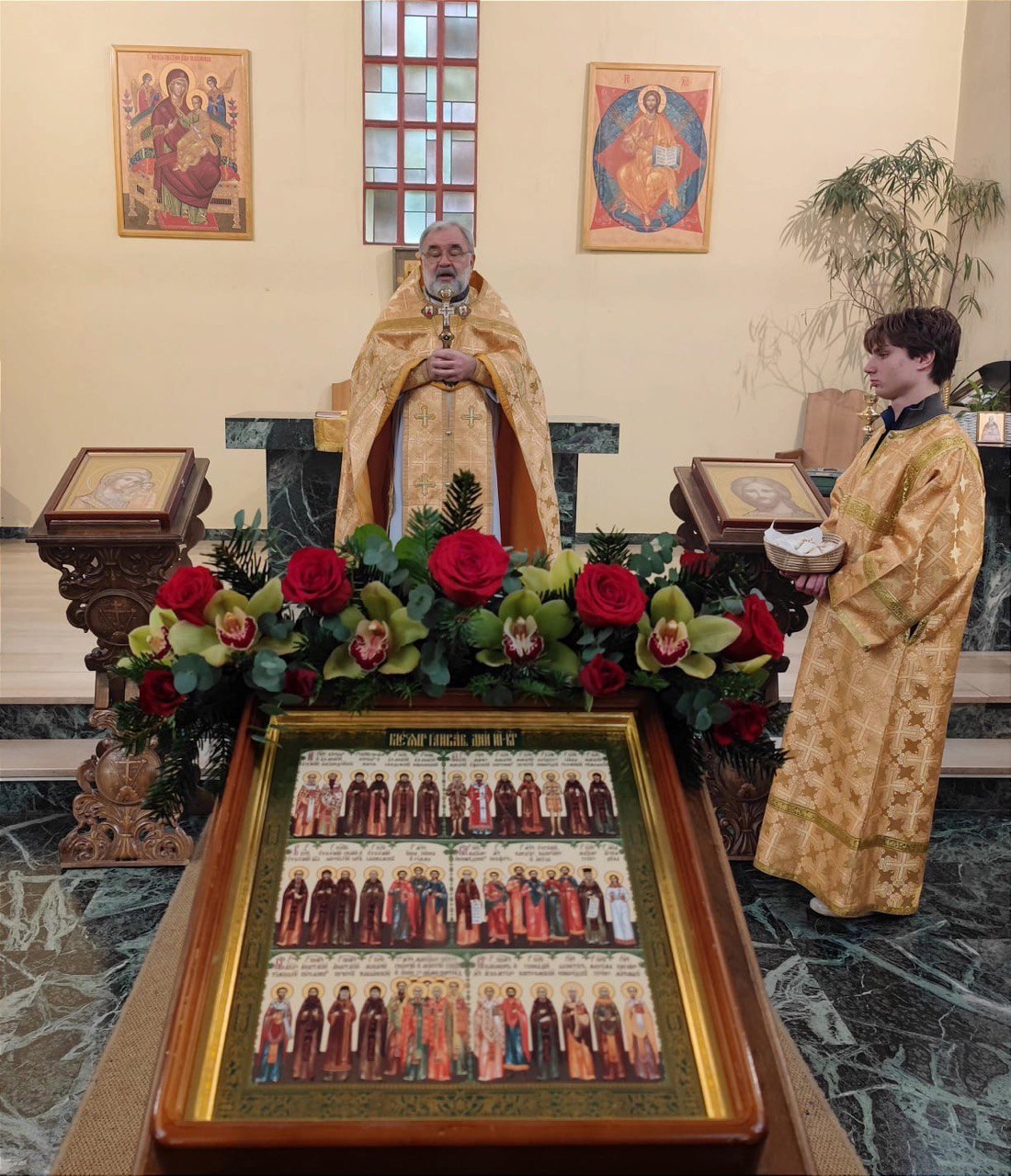
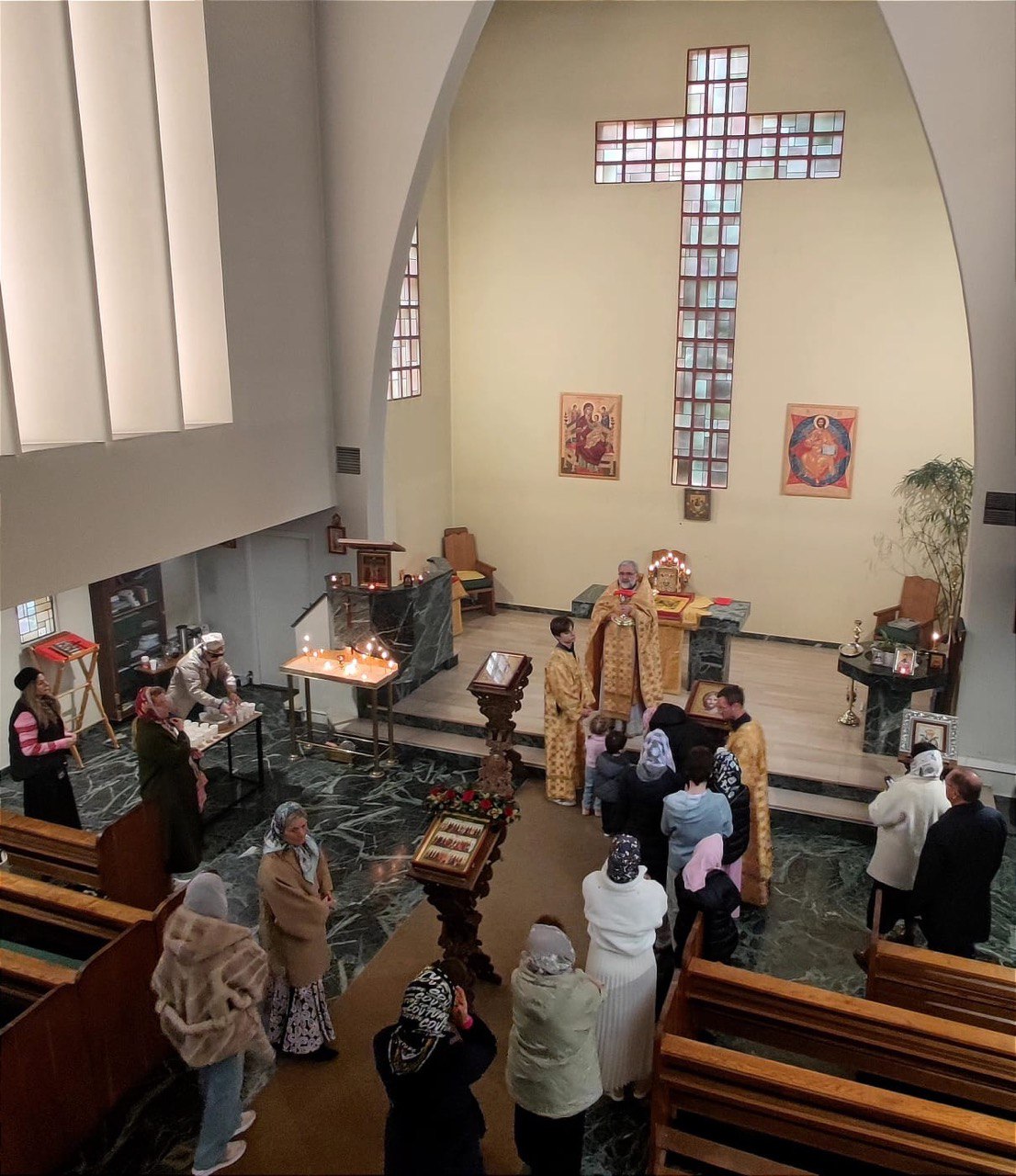
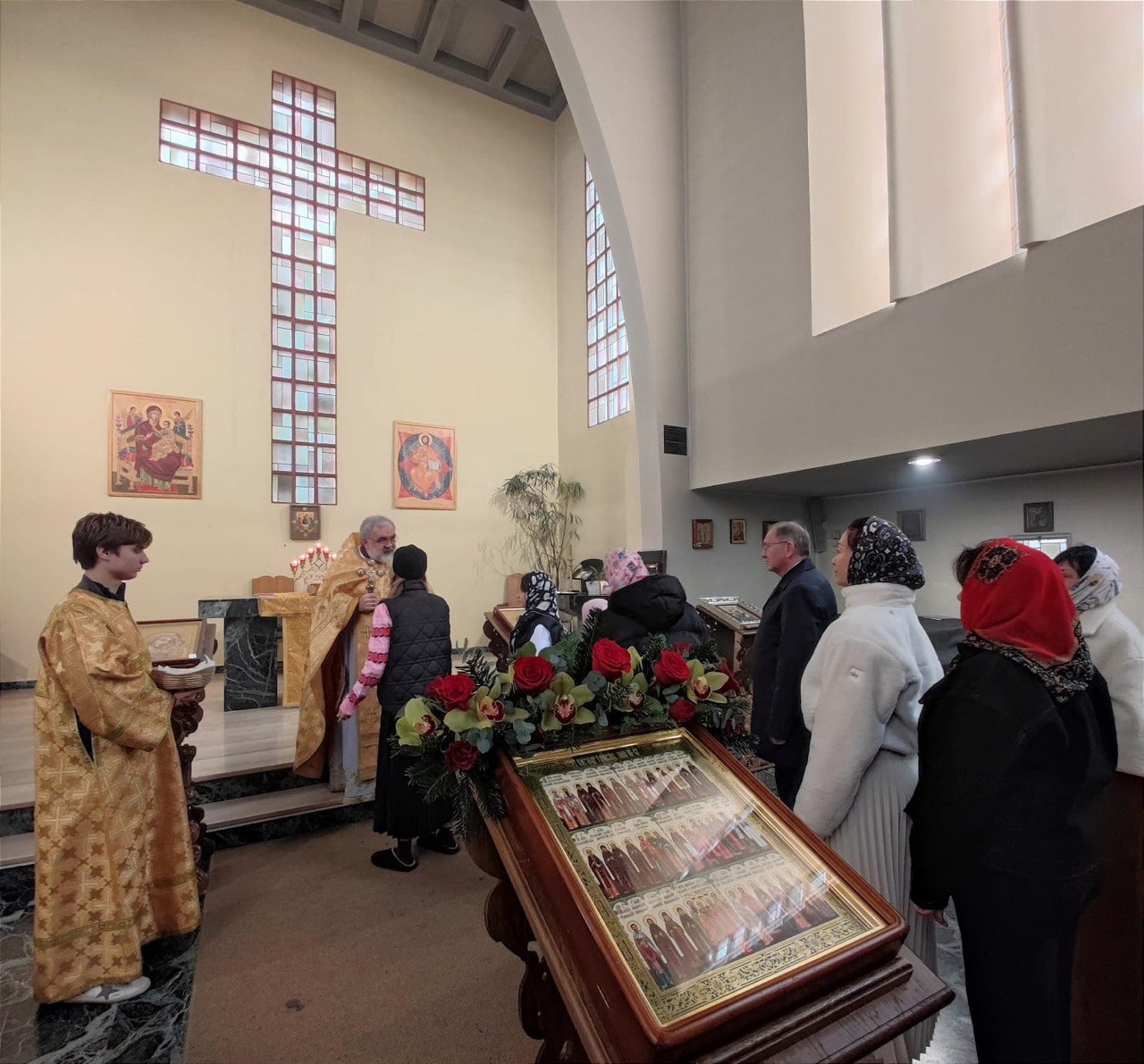
On Saturday of the 34th Week after Pentecost, the Divine Liturgy was celebrated, presided over by the rector of our parish, Archpriest Vadim Zakrevsky.
On this day, the Holy Church also commemorates:
• Saints Athanasius the Great (†373) and Cyril (†444), Archbishops of Alexandria
• Venerable Schema-monk Cyril and Schema-nun Maria (c. 1337), parents of Venerable Sergius of Radonezh
• Venerable Athanasius of Syandemsk (Syandebsk), of Vologda (after 1577)
• Righteous Athanasius of Navolotsk (16th–17th centuries)
• Venerable Marcian of Cyrus (†388)
• Hieromartyr Michael Kargopolov, Presbyter (†1919)
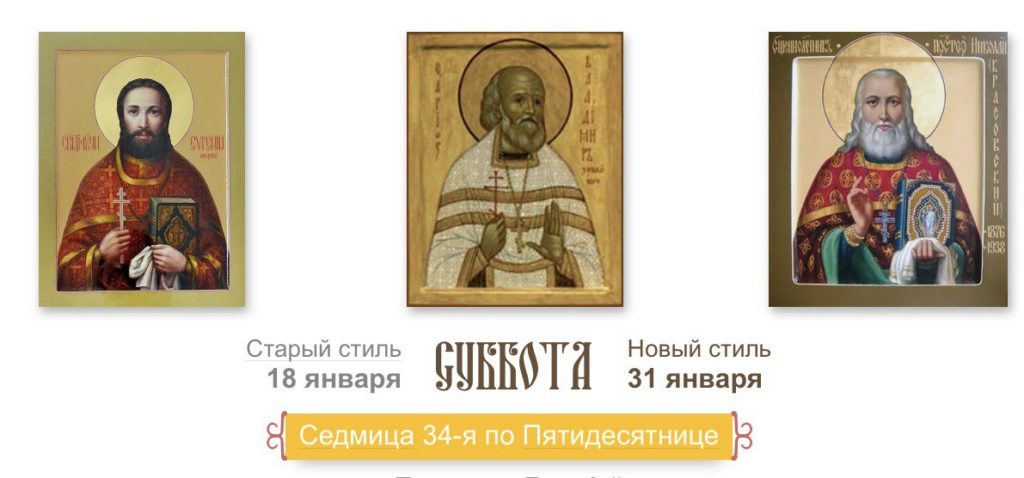
• Hieromartyr Eugene Isadsky, Presbyter (†1930)
• Hieromartyrs Vladimir Zubkovich, Nicholas Krasovsky, Sergius Lebedev, and Alexander Rusinov, Presbyters (†1938)
In his sermon, the rector referred to the parable of the widow and the unjust judge, contained in the Gospel reading of the day. Father Vadim emphasized that although there was no one to defend the widow, no one to pay on her behalf, and although she herself had no means to bribe the unjust judge, through her persistence she achieved the outcome that the judge helped her without payment.
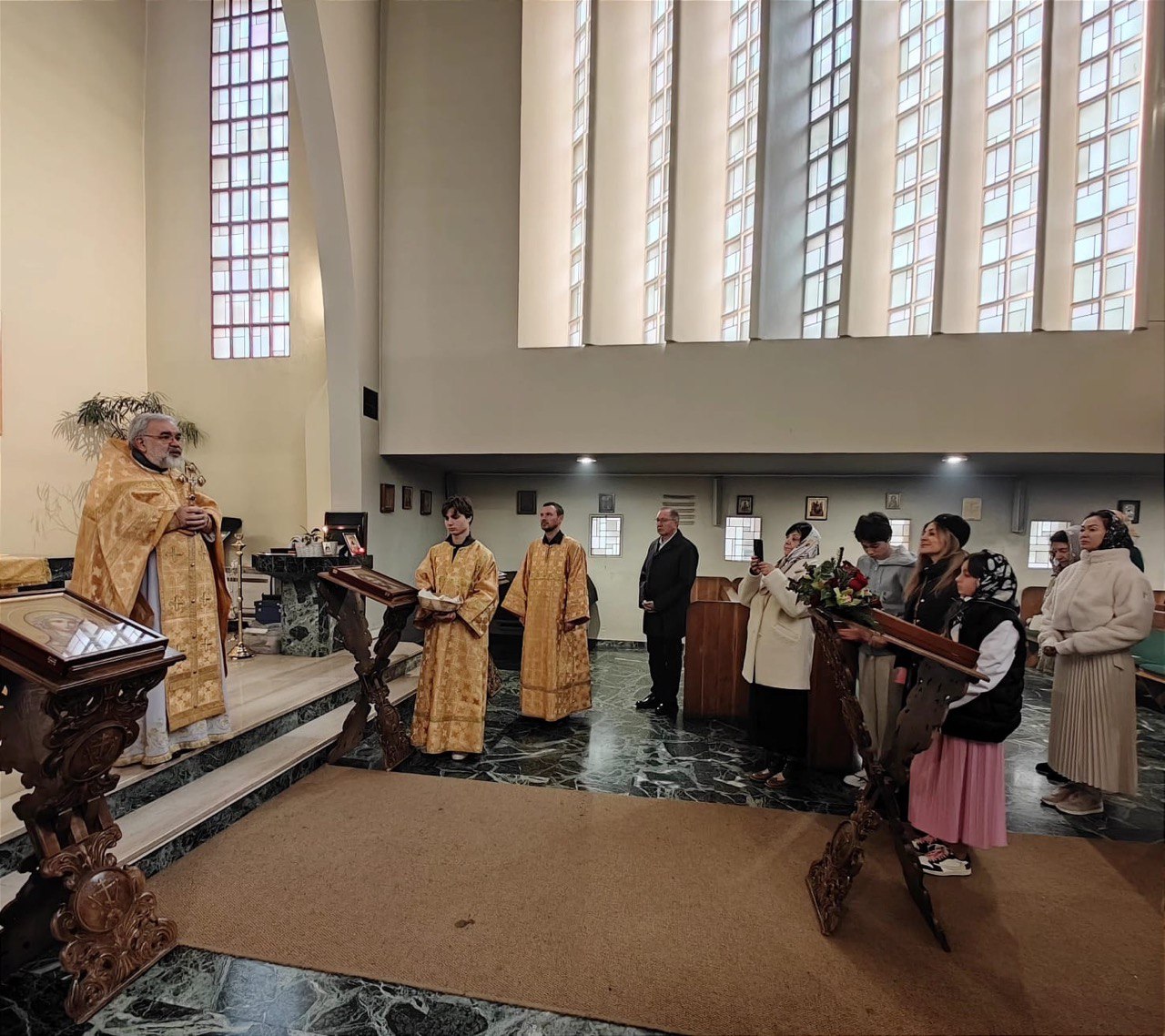
Father Vadim compared the widow’s persistence to the constant and sincere prayer that we ourselves must offer, hoping to receive what we ask for. He also compared this situation to a child’s requests to his parents. At the moment when a child asks his parents for something, it seems to him vitally important and greatly desired. However, after some time, the child may forget this request and ask for something else. From this, a connection was drawn to the fact that what we ask of God is not always truly necessary for us at a given moment, which may be one of the reasons why we do not receive what we ask for.
Special attention should be given to Father Vadim’s address to the parishioners at the conclusion of the service. In his remarks, he emphasized that all of us are beloved children of the Lord. In the life of a believer, situations often arise in which what one prays for does not come to pass, or does not happen immediately, at least at the initial stage.
To a certain extent, this continues the theme of the sermon delivered at the previous Divine Liturgy on the Saturday after Theophany, as mentioned in our earlier publication. Father Vadim explained that this may occur in two cases: either we turn to the Lord with insufficient faith, or what we ask for is not beneficial or necessary for us at the present time.
At the same time, one must not fall into despair or believe that the Lord does not hear us. The Lord hears everyone and sees everything. This matter is also connected with the spiritual condition of despondency, which in Church tradition is regarded as a sin. Despondency is, to some extent, related to lack of faith, since a person who fully entrusts himself to the will of God should not fall into depressive states because of life’s circumstances.
When a person entrusts his life to the Lord, he does not lose hope and does not lose a joyful outlook on the future. Despondency, on the contrary, reflects an absence of faith and an inability to perceive God’s benevolent Providence in one’s life. Father Vadim called upon the faithful to pay particular attention to these important spiritual matters.
Here it is also fitting to recall the words of Venerable Marcian of Cyrus, whose memory the Holy Church commemorates on January 31:
“Before God, brotherly love is higher than fasting. For God Himself gave the commandment of love, whereas ascetic struggle depends solely on our own free will.”
(The context of these words is presented below in the description of the saint’s life.)
Below we present brief summaries of the lives of the saints commemorated by the Holy Church on January 31.
Saint Athanasius the Great was born around the year 297 in Alexandria, into a virtuous Christian family. From childhood, Athanasius loved church worship so deeply that he organized games with his peers, appointing them as priests and deacons, while he himself, in the manner of a bishop, performed the church services with complete precision. When children from pagan families joined them, Athanasius spoke to them about Christ the Savior, and then, if they agreed, he performed baptism over them on the seashore. Saint Alexander, Bishop of Alexandria, took notice of this activity. Having ascertained that Athanasius performed the sacrament of Baptism correctly, he recognized it as valid and completed it with Chrismation. Summoning the parents of Athanasius, Saint Alexander asked them to raise the boy in learning and, when he came of age, to dedicate him to service in the Church.
When Saint Athanasius reached the age of twenty-one, Saint Alexander ordained him as a deacon of the Alexandrian Church. In this rank, Saint Athanasius accompanied the Patriarch in the year 325 to the First Ecumenical Council. At the Council, Saint Athanasius spoke in refutation of the heresy of Arius.
After the death of Saint Alexander, Deacon Athanasius was elected as his successor. While leading the Alexandrian Church, he continued the struggle against the heretics. Making use of support at the imperial court, they succeeded in obtaining the condemnation of the saint, who, as a result of their slander, was sent into exile in the year 336.
After the death of Emperor Constantine, Saint Athanasius returned from exile and continued to denounce the Arians. However, Constantine’s successor, Emperor Constantius, favored the Arians. By his order, an Arian was appointed Archbishop of Alexandria. Saint Athanasius departed for Rome to Pope Julius I, through whose efforts he was acquitted at the Council of Sardica in the year 343.
Despite many years of persecutions and trials, lasting in total more than twenty years, Saint Athanasius steadfastly defended the purity of Orthodox doctrine and tirelessly exposed the Arians. Saint Athanasius reposed on May 2, 373, leaving behind an exceedingly rich spiritual legacy.
In 431 the Third Ecumenical Council gathered in Ephesus, to which about 200 bishops arrived from all the Christian churches. The supporters of Nestorius were late to the council. For this reason Nestorius did not agree to the opening of the council, and when it nevertheless began its work, he did not appear at the session. The Council of Ephesus, over which Saint Cyril presided, condemned the teaching of Nestorius as heresy.
Nestorius did not submit to the council and did not repent, and the arriving Patriarch John of Antioch opened a separate council which declared Saint Cyril a heretic. The enemies of Orthodoxy slandered Saint Cyril, and by order of the emperor he was imprisoned together with the Bishop of Ephesus, Memnon.
However, the intrigues of the heretics were soon exposed, and the saint was released.
Nestorius, however, was deposed and sent into exile, where he died in severe suffering. Saint Cyril governed the Church of Alexandria for thirty-two years.
During this time he purified the Church from all the heresies that then existed and wrote many apologetic, dogmatic, exegetical, and moral works.
The saint reposed around the year 444. At his falling asleep the Most Pure Mother of God herself was present, whom he had faithfully served throughout his life.
VENERABLE MARCIAN OF CYRRHUS
Venerable Marcian of Cyrrhus lived at the end of the fourth century in Syria, then part of the Eastern Roman Empire.
He left his homeland and noble family and settled in the Chalcidian desert near Antioch (today Antakya).
He built an extremely narrow hut where he lived in strict seclusion, alternating prayer, psalmody, and reading of Holy Scripture.
He ate once in the evening — about 80 grams of dry bread and a little water — always keeping hunger and thirst, taking only what was necessary to survive.
After some time two disciples joined him, Eusebius and Agapitus, each living in a separate hut but gathering for common prayer.
Marcian also arranged a cell for temporary visitors who sought instruction through Eusebius while the elder remained in silence and contemplation.
Once at night Eusebius saw Marcian surrounded by divine light bright enough to read Scripture.
On another occasion the saint stopped a charging wild beast by making the sign of the Cross and breathing toward it.
His fame spread widely. Archbishop Flavian of Antioch visited him with other hierarchs and officials seeking a word of edification.
Marcian replied that God already speaks through creation and Scripture, and that mere human words add little benefit.
When the renowned ascetic Avid came to visit, Marcian ordered vegetables prepared for the guest.
Avid objected that he never ate before evening, to which Marcian answered that although he also loved fasting,
love of the brother is higher than fasting, for God commanded love while ascetic discipline depends on human will.
By his teaching and example Marcian strengthened Orthodox faith against heresies that distorted the mystery of the Holy Trinity
or fell into extreme asceticism (such as the Messalians). He also helped establish canonical order in the Church,
including a common date for celebrating Pascha.
When his sister came with her son bringing food, Marcian refused to receive her gifts, saying they were motivated by human attachment rather than for God.
Before his death, knowing the hour of his repose, he made his disciple swear to bury him secretly. He reposed in 388.
VENERABLE CYRIL AND MARIA
Venerable Cyril and Maria lived in the Rostov principality.
Cyril served the Rostov princes; both spouses lived according to the Church, loved prayer and charity,
and raised their children in piety. They already had a son Stephen when Maria bore a second son, Bartholomew — the future Saint Sergius.
Even before his birth, Bartholomew gave a miraculous sign during the Liturgy, crying three times in his mother’s womb.
The parents vowed to dedicate him to God. Later, impoverished, they moved to Radonezh in the land of Moscow.
Their sons Stephen and Peter married, while Bartholomew desired the monastic life.
Out of obedience he waited until his parents’ death.
In old age Cyril and Maria entered the Pokrovsky Khotkovo Monastery, receiving first the monastic tonsure and then the Great Schema.
They reposed in peace around 1337.
Their veneration began in the sixteenth century. At their relics psalms were read continually and many miracles occurred.
During the years of persecution the monastery was devastated, but in 1989 the Pokrovsky Cathedral and the whole monastery were returned to the Church.